Some of the most magical learning moments I’ve ever seen as a teacher happened outside — not at a desk, not with a worksheet, but with a handful of leaves and a pot of paint on the grass.
Outdoor art activities for children open up a whole new world of creativity, sensory exploration, and early years learning. Nature provides an endless source of inspiration, and the outdoor environment removes the pressure of producing something “right” — children simply explore, create, and discover.
These five ideas are simple, genuinely low-cost, and designed to build real EYFS skills through play rather than formal teaching. For more hands-on early years activity ideas across maths, literacy, science, and movement, see our main guide: 5 EYFS Activities to Try at Home (Ages 3–5).
What this guide covers
- 5 outdoor art activities that build real EYFS skills
- What each activity teaches — from fine motor skills to scientific thinking
- Extension ideas to deepen learning as children grow
- Why outdoor creative play matters for early years development
Why outdoor art activities are so powerful for early years
Many people still think of art as something that only happens indoors with pencils and paintbrushes. But outdoor creative play develops skills across almost every area of the EYFS — often without children realising they’re learning anything at all.
Through outdoor art, children naturally develop:
Fine motor skills through natural manipulation of objects
Vocabulary by describing textures, colours, and shapes
Scientific thinking through exploring seasons, plants, and habitats
Imagination and storytelling through open-ended creative play
5 ideas to try
Outdoor art activities for children
Start with whichever one catches your eye — they all work brilliantly on their own.
1
Activity one
Leaf printing
Start with a nature walk or a wander into the garden. Ask children to collect a variety of leaves and notice the differences — some smooth, others jagged; some big and bold, others small and delicate. Then paint one side of each leaf and press it onto paper to create beautiful prints, revealing the veins, shapes, and natural patterns inside.
Skills gained: fine motor skills, observation, scientific thinking, vocabulary
- Encourage children to notice differences before collecting — colour, size, shape, texture
- Press the leaf firmly and peel back slowly to reveal the full print
- Pair symmetrical prints to create leaf butterflies, or arrange them into forest creatures
- Introduce a ruler or tape measure to explore standard units of measurement
- Sort by two attributes at once — e.g. long AND thin
- Use a simple chart to record which objects were longest or shortest
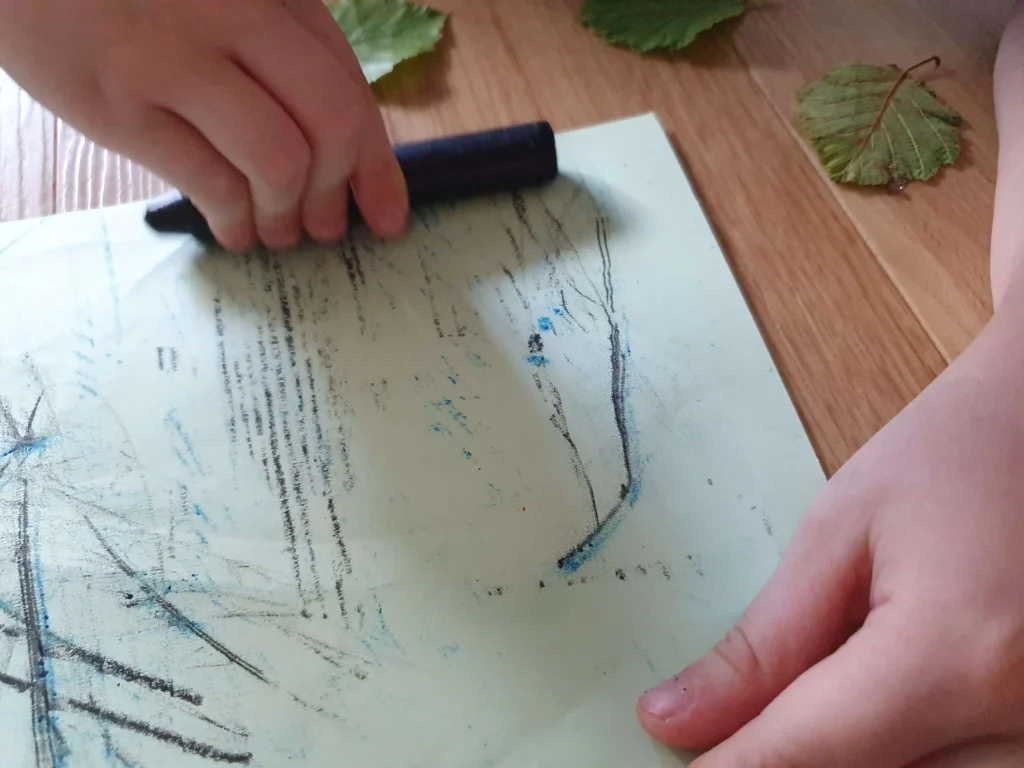
Leaf printing in action — every print is different, and every one is a discovery.
2
Activity two
Texture scavenger hunt
Give children a simple challenge: can you find something smooth? How about rough, bumpy, or soft? A texture scavenger hunt is a brilliant way to combine art, language development, and outdoor exploration — and children become engrossed in it far faster than you might expect.
Skills gained: descriptive language, observation, sensory development, scientific curiosity
- Challenge children to find something smooth, rough, bumpy, soft, wet, and dry
- Who can find the most different textures? Can you find three that feel the same?
- Extend by identifying plants, trees, and insects found during the hunt
- Count how many of each texture type they find — blends art, science and maths
- Make texture rubbings using paper and crayons held on their sides
- Sort found items by texture and photograph each group
Nature rubbings are a brilliant extension of this — see how we use them in our garden activities guide.
3
Activity three
Nature picture frames
Create simple frames using sticks tied together, or cut a window into a piece of cardboard. Take the frame outside and place it over different parts of the environment — a patch of grass, a section of bark, a corner of the flowerbed. Ask children to draw or paint exactly what they can see through the frame. Something as simple as a patch of grass suddenly becomes a detailed world full of daisies, ants, clover, and movement.
Skills gained: observation, concentration, mark-making, creativity, language
- Ask: what can you see inside your frame? How many different colours? How many living things?
- Draw or paint the framed view with pencils, chalk, or watercolours
- Move the frame to different spots and compare what changes
- Photograph the framed scene and compare perspectives between children
- Return to the same frame spot across different seasons and compare what’s changed
- Make frames from sticks tied with string for a fully natural version
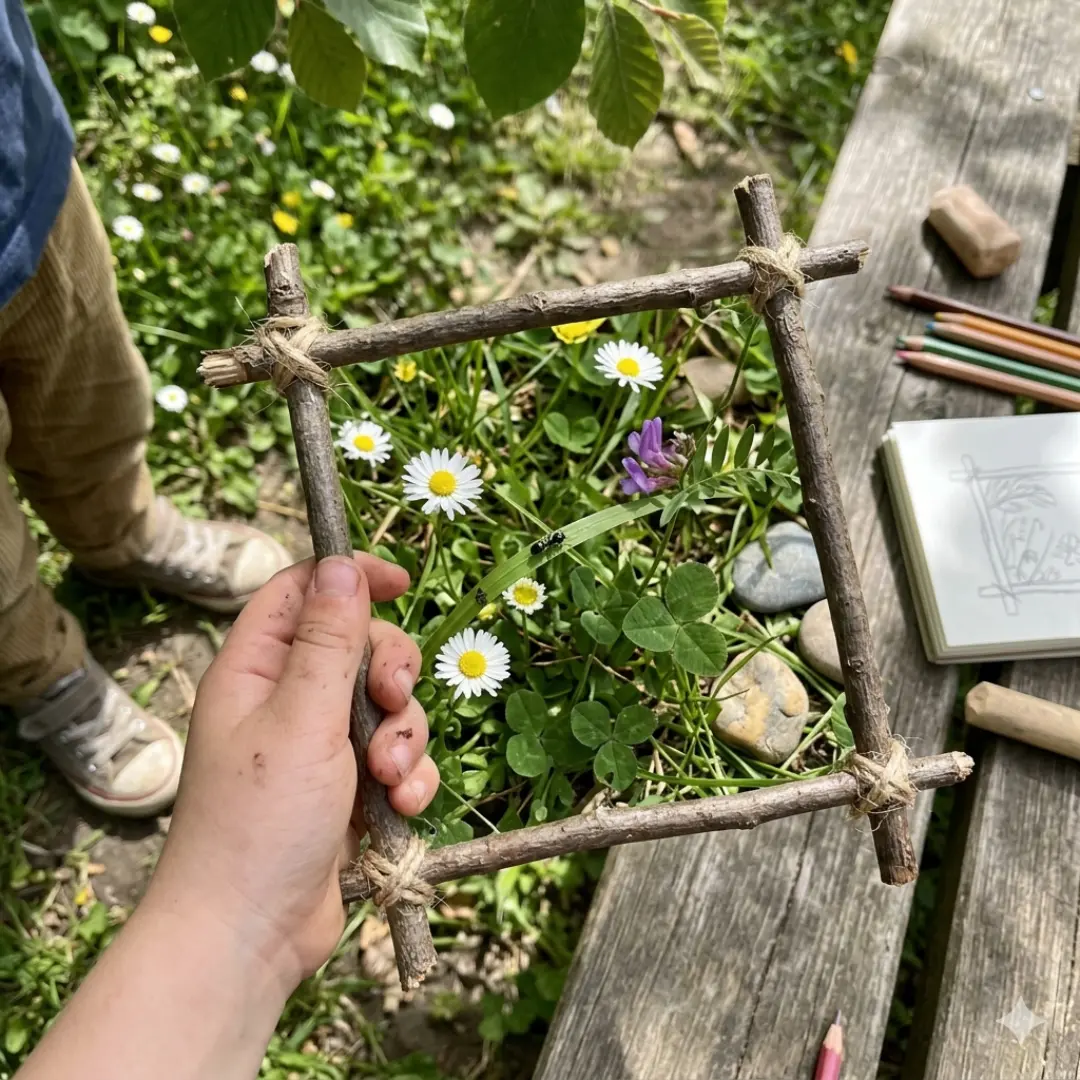
A simple stick frame turns any patch of garden into an artwork waiting to be discovered.
4
Activity four
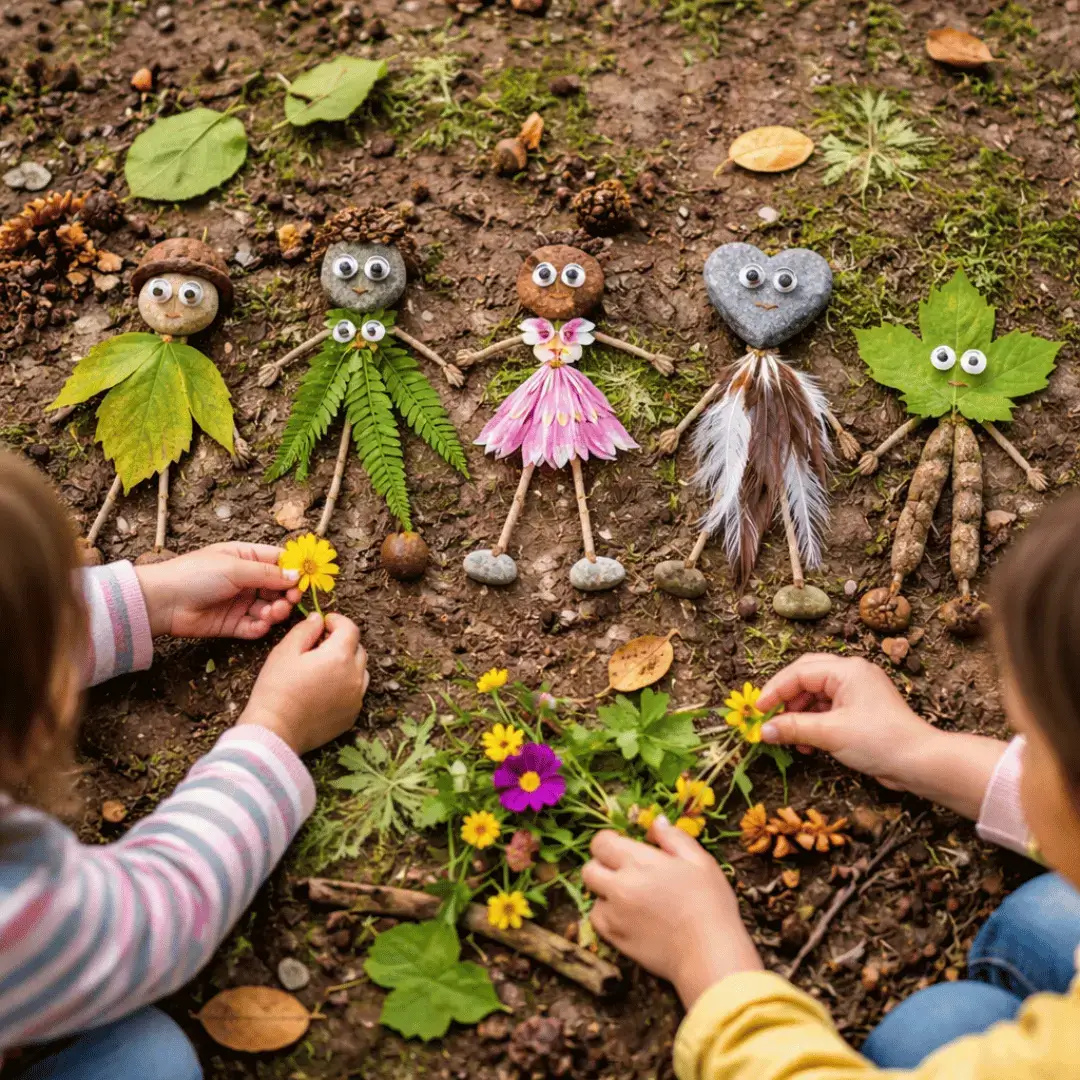
Nature people and creatures
Collect sticks, leaves, stones, petals, feathers — anything found outdoors — then challenge children to create “nature people” or imaginary creatures. One child might make a woodland fairy, another designs a five-headed leaf monster. There are no limits here, and no right answer. This is one of the most joyful, imaginative outdoor art activities for children of any age.
Skills gained: imagination, narrative skills, fine motor skills, collaborative play
- Ask: what will you use for the head? How many arms or legs? Where does it live?
- Once created, name the creature and tell the story of its adventures
- Work collaboratively to build a whole nature world together
- Photograph finished creatures and write or dictate a short story about them
- Create a whole nature scene — a forest, a village, an underwater world
- Use clay or playdough to give the creatures more permanent bodies
Nature people — where the story always starts after the making is done.
5
Activity five
Tea bag splat painting
This is one of those outdoor art activities children never forget. Soak used tea bags — fruit teas work beautifully for colour variation — in water, then lay out a large sheet of paper or lining paper. Children throw or drop the tea bags onto the surface and watch them splat and stain in completely unpredictable patterns: soft browns, pinks, purples, and golden tones blending together in unique abstract designs.
Skills gained: creative confidence, cause and effect, colour exploration, fine motor skills
- Use fruit teas for the best colour variety — each type gives different tones
- Lay out lining paper or an old sheet for the largest possible canvas
- Let children drop, throw, or drag the bags for different effects
- Once dry, turn splats into animals, faces, or landscapes using pen or paint
- Add pen details to create a collaborative “tea bag mural”
- Compare different tea types side by side — which makes the brightest colour?
Outdoor art is about so much more than making something pretty.
It’s about giving children permission to explore, experiment, and express themselves in a natural environment — with no pressure, no wrong answers, and no clean-up anxiety.
Children remember the feel of the leaves, the excitement of the splat, the laughter during a scavenger hunt. These experiences stay with them far longer than any worksheet ever could.
Common questions about outdoor art activities for children
Written by a mum & primary school teacher
I write about the practical, hands-on side of early years learning — the kind that fits into a real family day. For more ideas across maths, literacy, science, and movement, see our full guide to EYFS activities at home.