Maths doesn’t have to stay inside the classroom. In fact, some of the most powerful early maths learning happens outside — with a handful of sticks and absolutely no worksheets in sight.
As both a mum and a primary school teacher, I’ve seen how outdoor maths activities for early years help children aged 3–5 understand numbers, measurement, and shapes in a way that feels completely natural. When children are measuring real tree trunks, grouping real stones, and racing through real obstacle courses, maths stops being abstract and starts making sense.
These five activities need nothing you can’t find outside or around your home. They’re part of our wider guide to EYFS activities you can do at home — visit that if you’re looking for ideas across literacy, science, art and movement too.
What this guide covers
- 5 outdoor maths activities for EYFS children aged 3–5
- The specific skills each activity builds
- Extension ideas to deepen learning as children grow
- Why outdoor maths works differently to indoor maths
Why outdoor maths works so well for early years
When children handle real objects — measuring, sorting, counting things they found themselves — they build understanding that sticks. The outdoor environment adds scale, physicality, and genuine curiosity that a table-top activity simply can’t replicate.
Through outdoor maths play, children aged 3–5 naturally build:
Measuring and comparing: bigger, smaller, longer, shorter
Counting and grouping with real objects
Shape and geometry awareness in the environment
Active, kinesthetic learning that builds memory
5 activities to try
Outdoor maths activities for EYFS
Grab a bag, head outside, and start with whichever feels right today.
1
Activity one
Measure and compare length
Collect sticks, stones, leaves, or pinecones and explore which is longer, shorter, bigger, or smaller. Children can line objects from shortest to longest, or group them by size. Encourage them to use maths language naturally: longer, shorter, thicker, thinner, bigger, smaller.
Skills gained: counting, measuring, comparing, shape recognition, problem-solving
- Line sticks or leaves from shortest to longest
- Ask your child to predict which object will be longest before measuring
- Challenge them to build a line of objects as long as their arm
- Introduce a ruler or tape measure to explore standard units of measurement
- Sort by two attributes at once — e.g. long AND thin
- Use a simple chart to record which objects were longest or shortest
2
Activity two
Count and group natural objects
Gather natural objects — sticks, leaves, stones, pinecones — and count them into groups: 2 sticks per pile, 3 leaves per pile, 4 stones per pile. This introduces early multiplication and division concepts in a completely hands-on way that makes far more sense than numbers on paper.
Skills gained: counting, grouping, early multiplication and division, pattern recognition
- Count objects into equal groups — e.g. always 3 per pile
- Turn it into a sorting game by colour, size, or shape
- Ask your child to make patterns with the groups, e.g. stone-leaf-stone-leaf
- Encourage recording by drawing tallies on paper or a chalkboard
- Introduce “more than” and “fewer than” language between piles
- Ask: “How many altogether?” to introduce simple addition
3
Activity three
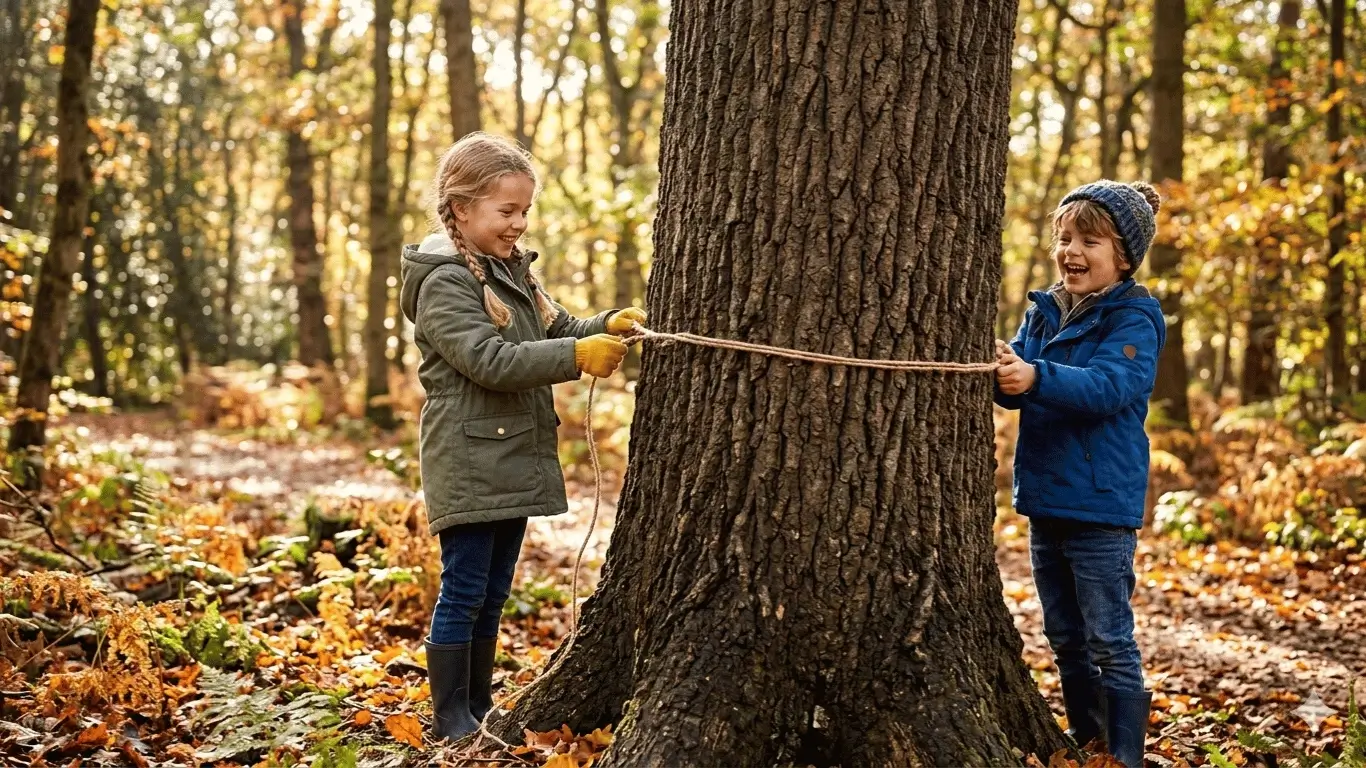
Measure tree trunks with string
Wrap a piece of string around tree trunks to measure their circumference. Compare trees of the same or different types and introduce tree names like oak, birch, and pine. It sounds simple — and it is — but it opens up a surprising amount of maths language and early geometry conversation.
Skills gained: measuring, comparing, geometry, nature awareness
- Ask your child to guess which tree is biggest before measuring
- Compare the strings side by side after measuring — which is longer?
- Talk about why different trees are different sizes
- Record measurements on a simple chart: tallest, widest, thickest trunk
- Compare the same trees across seasons and discuss changes
- Introduce the word “circumference” — children love a big word
4
Activity four
Counting obstacle course
Set up a simple outdoor obstacle course — jump to a tree, hop over stones, climb a hill — and count the steps, jumps, or hops along the way. Compare results between runs, or challenge siblings and friends. Moving and counting together is one of the most effective ways to make numbers genuinely memorable for young children.
Skills gained: counting, comparison, estimation, sequencing, active learning
- Count steps, jumps, or hops at each stage of the course
- Compare results between runs — was it more or fewer this time?
- Time each round to introduce early estimation and speed ideas
- Add number cards along the route where children must count objects before moving on
- Create a sequence of movements: hop 3 times, spin 2 times, jump 4 times
- Record results in a simple tally chart to see who hopped the most
5
Activity five
Shape hunt in nature
Go on a hunt for shapes in the natural environment and the built world around you. Look for triangles in leaves, circles in tree rings, rectangles in paving stones. Encourage children to ask — and answer — questions like: “How many sides does it have?” “How many corners?” “What shape is that?”
Skills gained: shape recognition, geometry, observation, problem-solving
- Hunt for triangles in leaves, circles in tree rings, rectangles in paving stones
- Photograph the shapes on a phone to create a nature shape collage at home
- Challenge your child to create their own shapes from sticks, leaves, or stones
- Introduce 3D shapes: cones (pinecones), cylinders (logs), spheres (stones)
- Sort found shapes by number of sides or corners
- Make a shape tally chart of everything found on the walk
Outdoor maths is hands-on, active, and genuinely fun.
These five activities encourage curiosity, build confidence, and make maths feel real and meaningful — all while getting children moving and exploring. You don’t need to be a maths teacher. You just need to be outside together.
Whether you’re in the garden, at the park, or walking in the woods, the natural world is full of maths waiting to be discovered.
Common questions about outdoor maths for early years
Written by a mum & primary school teacher
I write about the practical, hands-on side of early years learning — the kind that fits into a real family day. For more EYFS activity ideas across maths, literacy, science, art, and movement, see our full guide to early years activities at home.