

Maths doesn’t have to stay inside the classroom. Outdoor maths activities for early years help children aged 3–5 (EYFS) explore numbers, shapes, measurement, and problem-solving while having fun. Nature provides endless opportunities to make maths hands-on, active, and meaningful.
These activities are simple, playful, and require little more than what you can find outside or around your home. Grab a bag, head outdoors, and let your child discover how maths is all around them.
Measure and Compare Length
Collect sticks, stones, leaves, or pinecones and see which is longer, shorter, bigger, or smaller. Children can line objects from shortest to longest or group them by size. Encourage them to use maths language such as longer, shorter, thicker, thinner, bigger, and smaller.
Extension ideas:
📏 Ask your child to predict which object will be the longest before measuring.
📏 Use a ruler or tape measure to introduce standard units of measurement.
📏 Challenge them to build a line of objects that matches a certain length, e.g., “Make a line as long as your arm.”
Why it matters: Measuring and comparing develops early numeracy, spatial awareness, and problem-solving skills.
Skills gained: measuring, comparing, sorting, maths vocabulary
2.
Count and Group Items
Gather natural objects and count them into groups:
📏 2 sticks per pile
📏 3 leaves per pile
📏 4 stones per pile
This introduces early multiplication and division concepts in a fun, hands-on way.
Extension ideas:
📏 Turn it into a sorting game by colour, size, or shape.
📏 Ask your child to make patterns with the groups, e.g., stone-leaf-stone-leaf.
📏 Encourage them to record the numbers by writing or drawing tallies on paper or a chalkboard.
Why it matters: Grouping objects helps children understand numbers, counting, and the concept of sets, laying the foundation for more complex maths.
Skills gained: counting, grouping, early multiplication and division, pattern recognition
Measure Tree Trunks with String
Wrap a piece of string around tree trunks to measure their circumference. Compare trees of the same or different types, and teach your child tree names like oak, birch, and pine.
Extension ideas:
📏 Ask your child to guess which tree is biggest before measuring.
📏 Compare trees across seasons and discuss changes, introducing observational skills.
📏 Record measurements on a simple chart to see which tree is tallest, widest, or has the thickest trunk.
Why it matters: Measuring tree trunks introduces early geometry concepts and strengthens observation and critical thinking skills.
Skills gained: measuring, comparing, observation, nature awareness
4.
Counting Obstacle Course
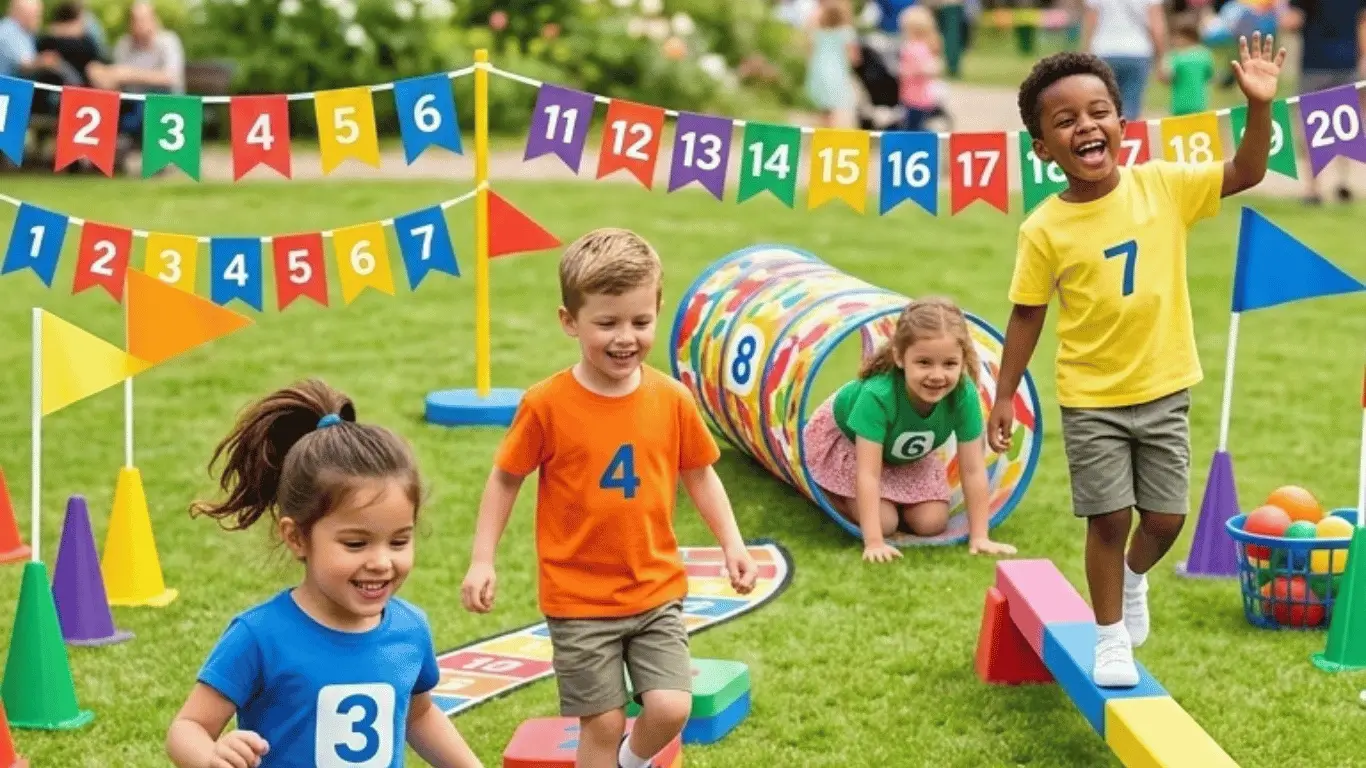
Set up a mini outdoor obstacle course: jump to a tree, climb a hill, hop over stones. Count steps, jumps, or hops, then compare results. Children can challenge siblings or friends, turning it into a friendly competition.
Extension ideas:
📏 Time each round and compare results, introducing estimation and speed concepts.
📏 Add number cards along the course where your child must count objects before moving on.
📏 Create a sequence of movements (e.g., hop 3 times, spin 2 times) to reinforce patterns and sequencing.
Why it matters: Combining movement and counting makes maths active and memorable, supporting children who learn best through kinesthetic experiences.
Skills gained: counting, comparison, estimation, active learning, sequencing
5. Shape Hunt
Go on a hunt for shapes in nature and the environment:
📏 Triangles in leaves
📏 Circles in tree rings
📏 Rectangles in paving stones
Ask your child questions like: “How many sides?” “How many corners?” or “What shape is it?”
Extension ideas:
📏 Take a camera or smartphone to photograph the shapes, then create a collage at home.
📏 Encourage your child to create their own shapes from sticks, leaves, or stones.
📏 Introduce simple 3D shapes like cones, cylinders, or spheres using pinecones, stones, or logs.
Why it matters: Shape hunts help children develop geometry awareness, problem-solving skills, and observational abilities while making learning interactive and playful.
Skills gained: shape recognition, geometry, observation, problem-solving
Bonus Tips for Parents
📏 Keep it short and fun: 10–15 minutes of outdoor maths is enough to capture attention.
📏 Encourage conversation: Ask questions, let your child make predictions, and celebrate discoveries.
📏 Use a collection bag: Let children gather sticks, stones, and leaves to make counting and measuring more interactive.
📏 Adapt to the season: Rainy days? Try counting raindrops or leaves inside. Snow? Build shapes in snow or measure snow depth.
Our Final Thoughts
Outdoor maths is hands-on, fun, and engaging. It encourages curiosity, builds confidence, and makes maths feel real and meaningful. Best of all, it gets children moving, exploring, and learning at the same time.
Whether you’re in your garden, at the park, or walking in the woods, these 5 fun outdoor maths activities for early years help children see that maths is everywhere around them.