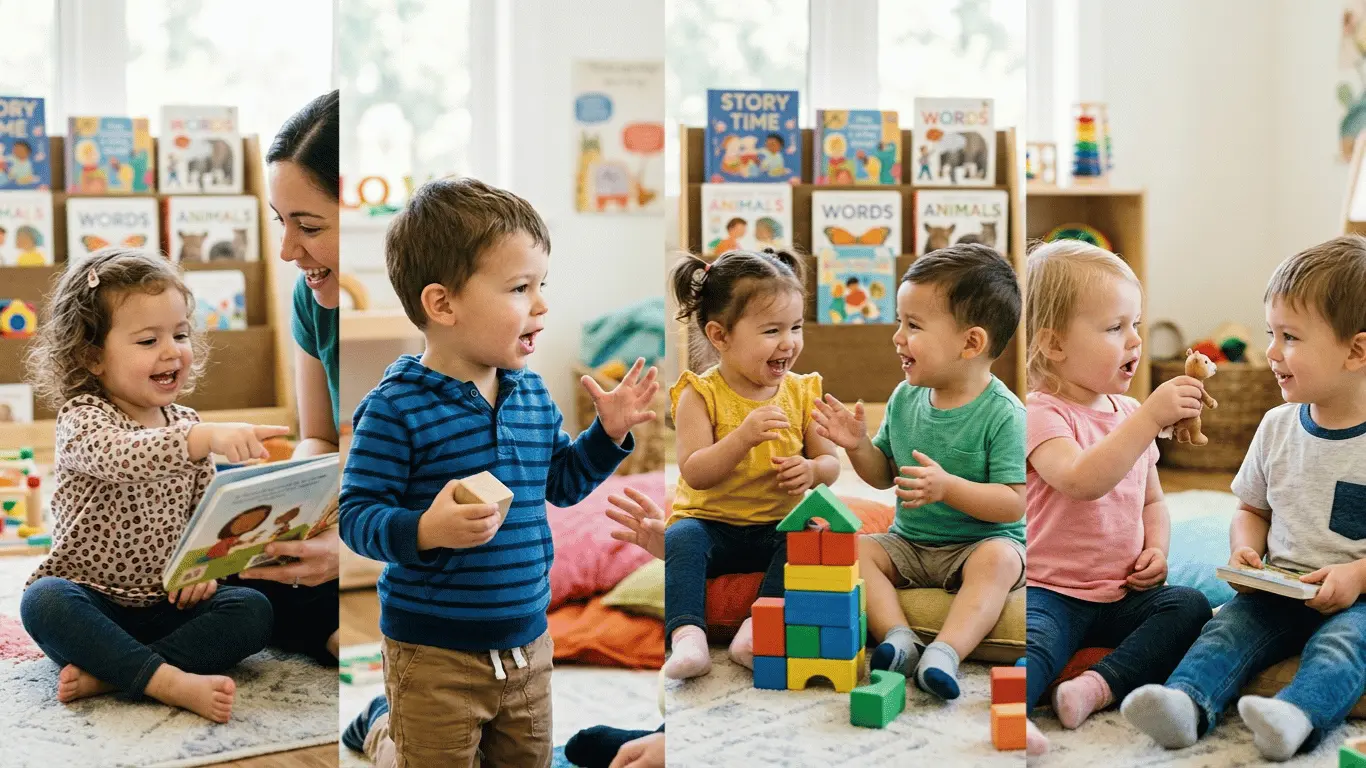
Between ages 1 and 3, toddler language development moves faster than almost any other period in a child’s life. One day it’s single words. A few months later, they’re asking “why?” about absolutely everything — and you wouldn’t have it any other way.
As an Early Years educator, I’ve seen how small, everyday interactions can have a dramatic impact on a toddler’s speech and communication. The good news is that supporting language development doesn’t need to be complicated — it happens naturally through talking, playing, singing, and reading together.
This guide covers five things every parent should know about toddler language development at ages 1–3. It sits within two of our wider guides: our complete guide to early language development from birth to age 5, and our guide to EYFS activities you can do at home — both are worth a read alongside this one.
What this guide covers
- Typical language milestones for ages 1, 2, and 3 — and what they mean
- How everyday moments build vocabulary and communication
- Why play is one of the most powerful language tools you have
- How to respond to your toddler’s “why” phase
- When to seek support — and how to do it without worry
Why toddler language development matters so much
The 1–3 age window is one of the most significant periods for language acquisition in a child’s entire life. Strong early communication skills don’t just support speech — they build the foundations for confidence, relationships, literacy, and learning throughout childhood.
Through everyday language-rich experiences, toddlers develop:
Vocabulary
Learning new words through repetition and context
Comprehension
Understanding language before they can say it
Turn-taking
The back-and-forth rhythm of conversation
Confidence
Feeling heard and understood builds self-expression
5 things to know
Toddler language development ages 1–3
Read all five — but don’t feel you need to act on them all at once.
1
point one
Every toddler develops at their own pace
There is a wide range of “normal” when it comes to toddler speech, and it’s wider than most parents expect. Some toddlers are early talkers, producing clear words well before their first birthday. Others take longer to find their words — and catch up completely. Both are usually perfectly fine.
Typical milestones — ages 1 to 3
around 12 months
- First meaningful words appear
- Uses gestures like pointing or waving
- Responds to their own name
By Around 2 years
- Two-word phrases begin (“more milk”)
- Vocabulary of around 50+ words
- Follows simple two-step instructions
Approximately 3 years
- Simple sentences of 3–4 words
- Asks lots of “why” and “what” questions
- Understood by others most of the time
- Celebrate every new word or gesture — progress, not perfection
- Compare your child to their own journey, not other children’s
- Keep a casual note of new words — you’ll be surprised how quickly the list grows
For a full breakdown from birth to age 5, see: Early Language Development in Children: A Parent’s Complete Guide.
2
point two
Everyday moments are your best language tool
Toddlers learn language through real-life experiences, not structured lessons. Narrating what you’re doing, describing the world around you, and asking questions as you go are among the most powerful things you can do — and they require no preparation at all.
- Talk through snack time: “you’re pouring the milk — it’s white and cold”
- Comment on their play: “you put the car on the ramp — it’s going so fast!”
- Ask open-ended questions: “what sound does that dog make?”
- Name objects and actions as you move through the day together
3
point three
Play is a powerful language teacher
Play isn’t a break from language learning — for toddlers, it is language learning. Pretend play, role-playing, and interactive games give children a safe space to experiment with new words, take turns in conversation, and describe feelings and ideas without any pressure to get it right.
- Encourage pretend play — shops, kitchens, and character games all generate rich vocabulary
- Read the same books repeatedly — familiarity builds confidence to join in
- Sing nursery rhymes daily — leave gaps for your child to fill in
- Follow their lead in play rather than directing it — they’ll talk more
For a deeper look at why songs matter so much: 5 Powerful Benefits of Nursery Rhymes for Early Childhood Development.
4
point four
Encourage questions and exploration
Around ages 2–3, toddlers enter what parents often call “the why phase” — asking questions relentlessly about everything they encounter. This curiosity is one of the best signs of healthy language development, not a challenge to manage. Responding with genuine enthusiasm is one of the most valuable things you can do.
- Answer questions clearly, even briefly — “the frog jumps because its legs are very strong”
- Introduce new words in context: “the frog is jumping into the pond — that’s a pond, like a small lake”
- Model complete sentence structure in your answers without correcting their grammar directly
- Ask questions back — “what do you think? why do you think that?”
5
point five
Early support is always worth seeking
While every toddler develops differently, there are times when a conversation with a professional is genuinely helpful — not because something is definitely wrong, but because early support, if it turns out to be needed, makes a real difference. Seeking advice is never overreacting. It’s good parenting.
- Trust your instincts — you know your child better than anyone
- Mention any concerns at your toddler’s health visitor check or GP appointment
- Keep a brief note of new words and phrases to share — it helps professionals assess progress
Signs it’s worth having a conversation with your health visitor or GP
These aren’t causes for alarm — just prompts to seek a professional opinion sooner rather than later:
- No words at all by 15–18 months
- Not combining two words by age 2
- Very difficult to understand by age 3
- Seems frustrated when trying to communicate
- Has lost words or skills they previously had
In many areas you can self-refer to NHS Speech and Language Therapy — your health visitor can advise on this for your local area.
Toddler language development thrives on connection, not perfection.
Talking, listening, singing, reading, and playing together build a foundation for communication, confidence, and learning. Small, consistent interactions matter far more than planned lessons or structured activities.
By weaving language into daily life, you’re giving your toddler the tools to express themselves, connect with others, and thrive — one conversation at a time.
Common questions about toddler language development
Written by an Early Years educator & mum
With over a decade in early years education and children of my own, I write about the practical, honest side of child development — because parents deserve clear information, not just reassurance. For our full language development guide from birth to age 5, visit Early Language Development: A Parent’s Complete Guide.